自訂資料型態與應用—
為什麼需要自訂資料型態?
「到目前為止,我們學過 int、double、char、bool。它們都很像單一格子的容器:一格放整數、一格放小數、一格放字元。
但是,如果現在要在程式裡表示一位學生,我們需要姓名、學號、國文、數學與英文成績。請問一個 int 裝得下嗎?」
「不是資料放不進電腦,而是單一基本型別無法表達這些資料屬於同一個人。真實世界的東西通常具有很多特徵。一位學生有姓名和成績;一本書有書名、價格和庫存;一個圓有半徑和面積。struct 就是讓我們替這種『由多項資料組成的東西』設計一張資料藍圖。」
高中程度比喻:以申請表為例
把結構想成學校設計的一張空白學生資料表:
空白表格是「格式」,不是某位學生。struct Student 是格式;Student may 才是一份屬於 May 的實際資料。
struct Student {       // 型別:藍圖
    string id;         // 成員
    string name;       // 成員
    int chinese;       // 成員
    int math;          // 成員
    int english;       // 成員
};                     // 分號不可漏

Student may;           // 物件:依藍圖造出的實體
- 宣告型別不等於建立資料:
struct Student { ... };只是告訴編譯器 Student 由哪些成員組成。直到寫出Student may;,程式才建立一個實際物件。
類比:建築設計圖不等於房子;同一張設計圖可以蓋很多間房子。
- 每個物件有自己的成員
- 為什麼結構結尾有分號?
右大括號關閉的是型別定義,分號結束整個宣告。初學者最常漏掉它,錯誤訊息卻可能出現在下一行。
範例:基本struct
#include <iostream>
#include <string>
using namespace std;

struct Student {
    string id;
    string name;
    int chinese;
    int math;
    int english;
};

int main() {
    Student may{"92013368", "May", 80, 75, 92}; // 同時建立與初始化物件。
    cout << "學號:" << may.id << '\n'; // `may.id` 中的點號讀作「may 的 id」。 -> 點號左側是物件,右側是該型別內存在的成員。
    cout << "姓名:" << may.name << '\n';
    cout << "三科:" << may.chinese << ", " << may.math << ", " << may.english << '\n';
}
Problem.
設計 Book 結構,包含:書名、作者、價格、庫存。建立兩本書並輸出。
宣告、初始化、存取與複製
「知道藍圖之後,下一步就是如何替每份資料填表。C++ 常見三個動作:建立、初始化、讀寫。建立是拿到一張新表;初始化是在誕生當下填資料;指定則是物件建立後再修改。」
三種寫法
Student a;                         // 建立,基本型別成員可能尚未有可靠值
Student b{};                       // 值初始化,數值成員成為 0
Student c{"001", "May", 80, 75, 92}; // 聚合初始化
未初始化值
區域物件中的基本型別成員若未初始化,直接讀取會造成未定義行為。它不是「系統一定幫你填 0」。建議初學階段養成 {} 或成員預設值的習慣。
結構整體複製
範例:
#include <iostream>
#include <string>
using namespace std;
struct Student { string name; int score{}; };
int main() {
Student s1;
cout << "姓名:";
getline(cin, s1.name);
cout << "成績:";
cin >> s1.score;
Student s2 = s1; // 這會把各成員複製到新物件。之後修改 `s2` 的 `name` 不會修改 `s1`。
s2.name += "(副本)";
cout << s1.name << ":" << s1.score << '\n';
cout << s2.name << ":" << s2.score << '\n';
}
範例:
#include <iostream>
#include <string>
using namespace std;
struct Product {
    string name;
    int price{};
    int quantity{};
};
int main() {
Product a{"鍵盤", 1200, 3};
Product b{}; // 所有成員做值初始化
cout << a.name << ",庫存金額:" << a.price * a.quantity << '\n';
cout << "空白商品價格:" << b.price << ",數量:" << b.quantity << '\n';
}
Problem.
建立 Movie:片名、導演、年份、評分。要求:
- 使用
{}初始化。 - 印出所有欄位。
- 複製成另一物件並修改評分。
- 證明原物件沒有跟著改。
結構指標與記憶體位址
「電腦記憶體可以想成一排非常多的置物櫃,每個櫃子有編號。變數的值是櫃子裡的東西,位址則是櫃子號碼。普通變數保存資料,指標變數保存另一份資料的位置。」
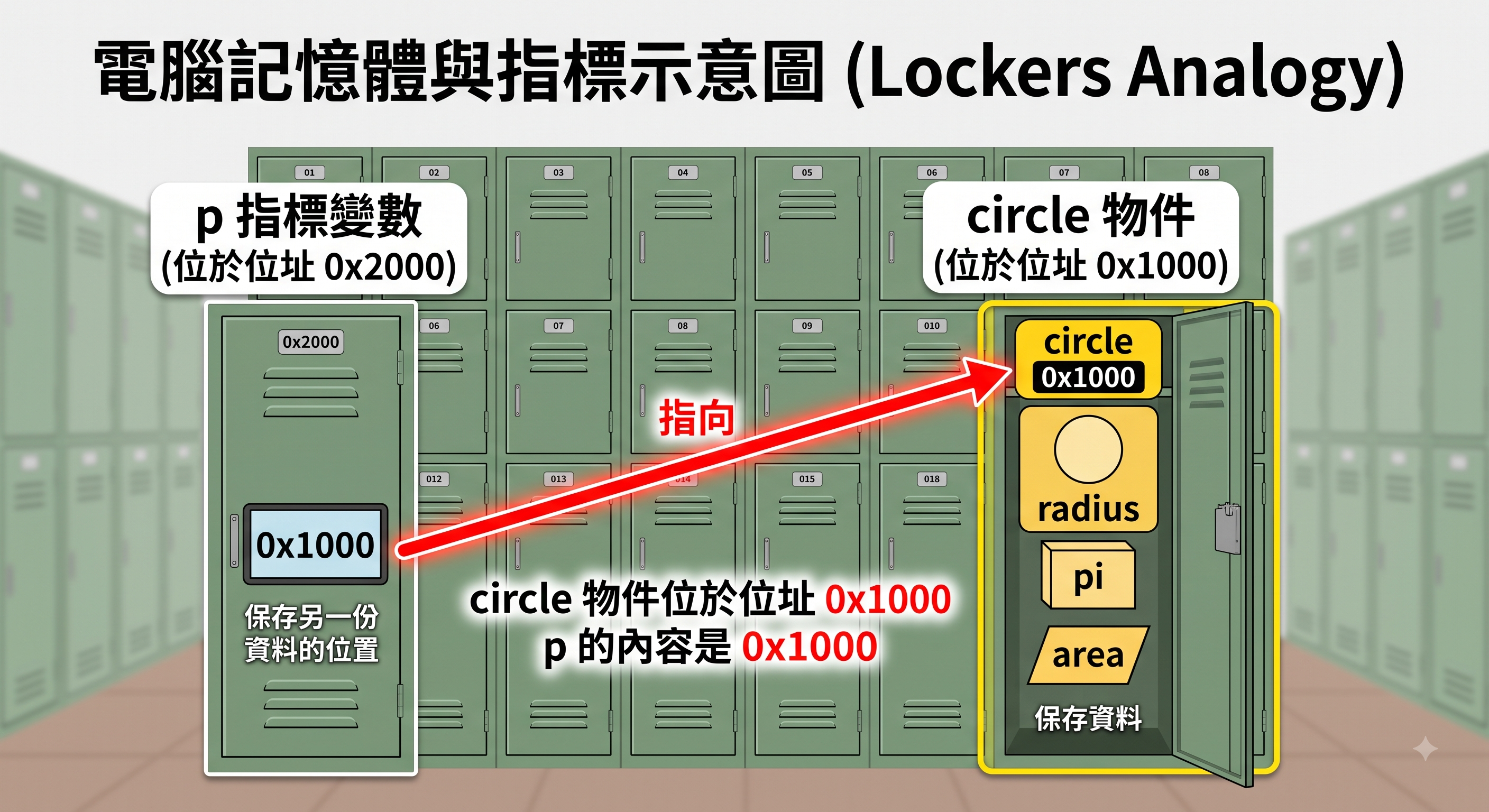
//// 一次釐清
Circle circle;       // 物件
Circle* p;           // 能保存 Circle 位址的指標
p = &circle;         // &circle:取得 circle 的位址
(*p).radius = 5;     // *p:沿位址找到物件
p->radius = 5;       // 上一行的簡寫
### `*` 為何有兩種意思?
- 宣告中:`Circle* p` 表示 p 是指標。
- 運算式中:`*p` 表示沿著 p 的位址找到那個物件,稱為解參考。

語言使用同一符號,但位置不同、功能不同。
nullptr
nullptr 表示目前沒有指向有效物件。不可執行 p->radius;就像只有「沒有地址」的紙條,卻要求郵差送信。
函式收到指標時,應視情況檢查:
結構陣列
一個 Student 像一張學生卡;Student students[5] 像有五格的卡片盒,每格放一張完整學生卡,而不是五個零散姓名。
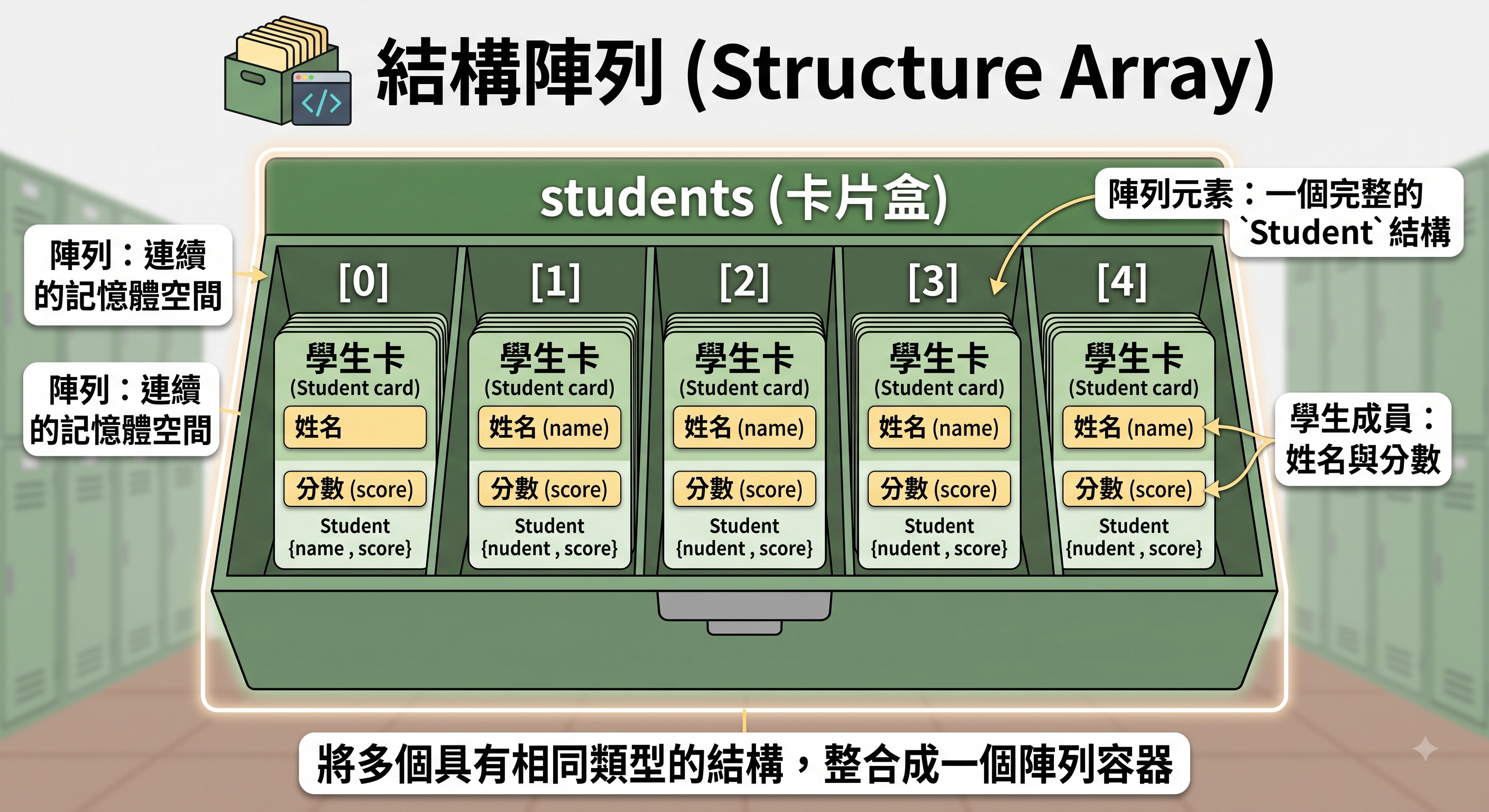
//// 語法拆解
students[i].score

// 按動作順序讀:
// 1. `students[i]`:取第 i 位學生物件。
// 2. `.score`:再取該物件的 score 成員。
// 初始化
Student students[] {
    {"Justin", 90},
    {"Monor", 95},
    {"Becky", 98}
}; // 每一組內層大括號是一個 Student,外層大括號是整個陣列。
範例:
#include <iostream>
#include <string>
using namespace std;

struct Student { string name; int score; };

int main() {
    Student students[]{{"Justin", 90}, {"Monor", 95}, {"Becky", 98}, {"Bush", 75}, {"Snoopy", 80}};
    int total = 0;
    for (const Student& s : students) {
        // - `const`:承諾不修改。
        // - `&`:使用原物件的別名,避免複製。
        // - `s`:每次代表目前那位學生。
        cout << s.name << ":" << s.score << '\n';
        total += s.score;
    }
    cout << "平均:" << static_cast<double>(total) / 5 << '\n';
}
先把它讀成「對 students 中的每一位學生 s」,語法細節稍後在函式章再回來。
結構指標陣列
//// 先辨認兩種完全不同的東西
Student students[5];   // 五個 Student 物件
Student* order[5];     // 五個指標,每個可指向 Student
// 第一個盒子直接裝學生卡;第二個盒子裝五張「地址紙條」。
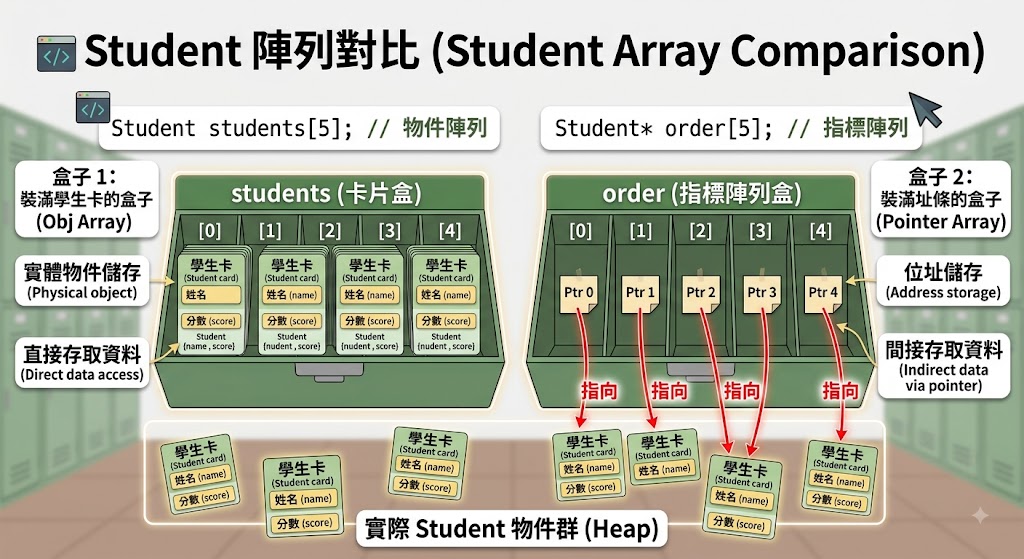
只重新排列指標,就能改變顯示順序,不必複製整個 Student。
範例:
#include <iostream>
#include <string>
using namespace std;

struct Student
{
    string name;
    int score;
};

int main()
{
    Student students[]{{"Justin", 90}, {"Monor", 95}, {"Becky", 98}};
    Student *order[]{&students[2], &students[0], &students[1]};
    for (Student *p : order)
        cout << p->name << ":" << p->score << '\n'; // 為什麼用 `->`?因為 p 的型別是 `Student*`,是指標。
}
巢狀結構
巢狀結構就是大容器裡放小容器。一個班級 Grade 裡包含多位 Student;一個地址 Address 可被包含在 Person 裡。
struct Student {
    string name;
    int height;
    int weight;
};

struct Grade {
    Student students[3];
    string teacher;
};

// 存取路徑
// grade.students[1].height
// 1. `grade` 這個班級物件。
// 2. 裡面的 `students` 陣列。
// 3. 第 1 個索引,也就是第二位學生。
// 4. 該學生的 `height`。
範例:
#include <iostream>
#include <string>
using namespace std;

struct Student{
    string name;
    int height;
    int weight;
};
struct Grade{
    Student students[3];
    string teacher;
};

int main(){
    Grade g{{{"John", 174, 65}, {"Justin", 168, 56}, {"Bush", 177, 80}}, "Mary"};
    cout << "導師:" << g.teacher << '\n';
    for (const Student &s : g.students)
        cout << s.name << ",身高 " << s.height << ",體重 " << s.weight << '\n';
}
函式與結構
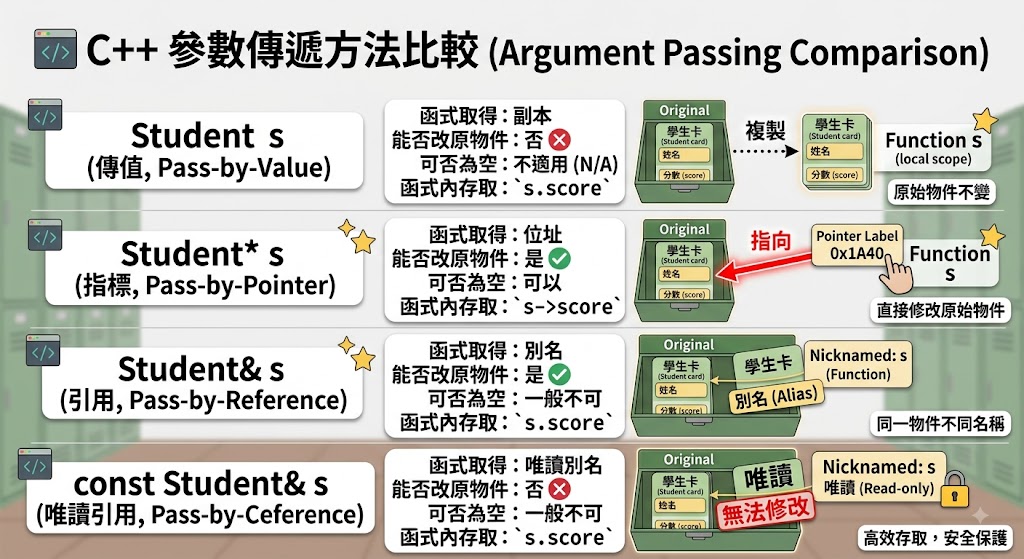
這是全章最重要、最容易混淆的一節。建議把三種方式並排教。
核心問題
把 Student 傳給函式時,函式拿到的是:
- 一份影印本?
- 原物件的地址?
- 原物件的別名?
這三種答案分別對應傳值、傳指標、傳參考。
傳值呼叫
交給函式一份學生資料的影印本。函式可以在影印本上塗改,原件不變。
- 函式參數是新物件。
- 修改參數不影響呼叫端。
- 大型結構複製可能有成本。
- 適合刻意需要副本的情況。
#include <iostream>
using namespace std;

// 傳值呼叫
void swapNumber(int a, int b) {
    int temp = a;
    a = b;
    b = temp;
    cout << "函式內:a = " << a << ", b = " << b << '\n';
}

int main() {
    int x = 10;
    int y = 20;
    cout << "交換前:x = " << x << ", y = " << y << '\n';
    swapNumber(x, y);
    cout << "交換後:x = " << x << ", y = " << y << '\n';
    return 0;
}
傳指標呼叫
把原件放在哪裡的地址交給函式。函式沿地址找到原件,所以可以修改原件。
- 呼叫端用
&student明確交出位址。 - 函式內用
->。 - 指標可以是
nullptr,必須處理沒有物件的可能。 - 常用於 C 介面、可選參數或資料結構操作。
#include <iostream>
using namespace std;

// 傳指標呼叫
void swapNumber(int* a, int* b) {
    int temp = *a;
    *a = *b;
    *b = temp;
    cout << "函式內:a = " << *a << ", b = " << *b << '\n';
}

int main() {
    int x = 10;
    int y = 20;
    cout << "交換前:x = " << x << ", y = " << y << '\n';
    swapNumber(&x, &y);
    cout << "交換後:x = " << x << ", y = " << y << '\n';
    return 0;
}
傳參考呼叫
沒有製作影印本,也沒有交地址紙條,而是替原件取一個函式內使用的別名。修改別名就是修改原件。
- 呼叫方式像普通變數。
- 函式內使用
.。 - 參考必須綁定有效物件,沒有一般的空參考用法。
- 現代 C++ 很常使用。
#include <iostream>
using namespace std;

// 傳參考呼叫
void swapNumber(int& a, int& b) {
    int temp = a;
    a = b;
    b = temp;
    cout << "函式內:a = " << a << ", b = " << b << '\n';
}

int main() {
    int x = 10;
    int y = 20;
    cout << "交換前:x = " << x << ", y = " << y << '\n';
    swapNumber(x, y);
    cout << "交換後:x = " << x << ", y = " << y << '\n';
    return 0;
}
const 參考
它通常是「只讀大型物件」的首選:
&避免複製。const防止意外修改。- 不需檢查
nullptr。
#include <iostream>
#include <string>
using namespace std;

struct Student {
    string name;
    int score;
};

// const 參考:不複製,也不允許修改
void printStudent(const Student& s) {
    cout << "姓名:" << s.name << '\n';
    cout << "成績:" << s.score << '\n';
    // s.score = 100;  // ❌ 錯誤:const 不允許修改
}

int main() {
    Student stu{"Justin", 90};
    printStudent(stu);
    return 0;
}
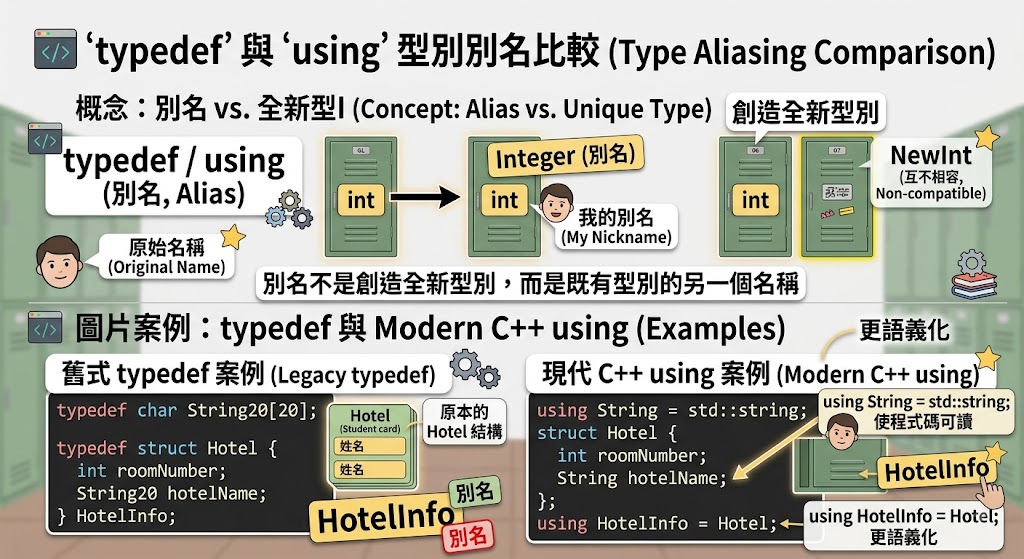
typedef 與 using
這兩者通常不是創造全新且互不相容的型別,而是替既有型別取另一個名稱。
// 以下兩種都是替既有型別(int)取另一個名稱(Integer)。
typedef int Integer;
using Integer = int;
// `Integer` 仍是 `int` 的別名。使用別名可提高可讀性,但命名若沒有增加意義,反而可能造成困惑。
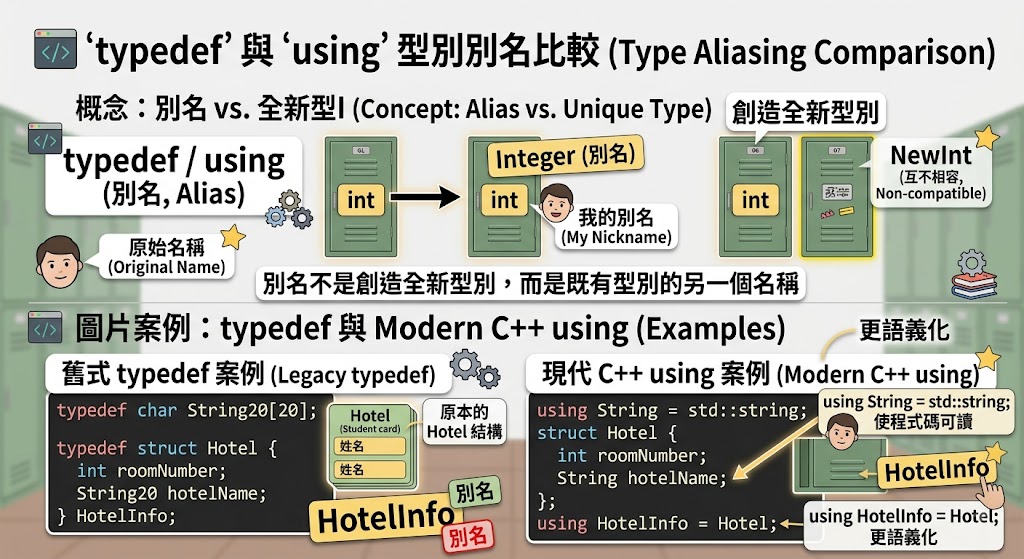
範例:
#include <iostream>
#include <string>
using namespace std;

typedef int Integer;
using Text = string;
typedef struct Hotel { Integer roomNumber; Text name; } HotelInfo;

int main() {
    HotelInfo hotel{10, "微風旅店"};
    cout << hotel.name << ",房間數:" << hotel.roomNumber << '\n';
}
列舉 enum
//// 使用enum
enum Drink { coffee, milk, tea, water }; // 程式直接表達「飲料是 tea」。
// 0, 1, 2, 3 -> 若未指定,第一個通常是 0,之後依序加 1:
Drink drink = tea;
//// 指定某一值後,後面繼續遞增:
enum Drink { coffee = 20, milk = 10, tea, water };
// coffee 20, milk 10, tea 11, water 12
範例:
#include <iostream>
using namespace std;

enum Drink { coffee = 10, milk, tea, water };

int main() {
    Drink choice = tea;
    cout << "coffee=" << coffee << '\n';
    cout << "tea=" << choice << '\n';
}
為何推薦 enum class?
傳統 enum 的列舉名稱會進入外部作用域,也較容易隱式當整數使用。enum class 需要完整名稱:
這樣更清楚,也減少不同列舉同名衝突。
switch 搭配列舉
列舉適合有限且事先知道的狀態,例如:星期、交通燈、訂單狀態、會員等級。若選項由使用者隨時新增,列舉未必合適。
switch (light) {
    case TrafficLight::red:    return "停止";
    case TrafficLight::yellow: return "準備";
    case TrafficLight::green:  return "通行";
}
範例:
#include <iostream>
using namespace std;

enum class TrafficLight { red, yellow, green };
const char* action(TrafficLight light) {
    switch (light) {
        case TrafficLight::red: return "停止";
        case TrafficLight::yellow: return "準備";
        case TrafficLight::green: return "通行";
    }
    return "未知";
}

int main() { cout << action(TrafficLight::green) << '\n'; }
聯合 union
struct 像每位成員都有自己的房間;union 像多位成員共用同一個房間,任何時刻通常只有目前放進去的那一種資料有效。
宣告與存取
語法仍用 .;若是聯合指標則用 ->。
範例
#include <iostream>
using namespace std;

union Data
{
    int number;
    float decimal;
    char letter;
};

int main()
{
    Data data{};
    cout << "union 大小:" << sizeof(data) << '\n';
    data.number = 65;
    cout << "目前有效成員 number:" << data.number << '\n';
    data.letter = 'A'; // 覆蓋同一塊儲存空間
    cout << "改存 letter:" << data.letter << '\n';
    // 此時不再讀 number;在 C++ 中任意讀非作用中成員不安全。
}
union 怎麼知道目前是哪一種?
union 只負責共用記憶體,它不會記得「現在裡面放的是誰」。
範例
#include <iostream>
using namespace std;

// 用來記錄 union 現在存哪一種資料
enum class ValueKind {
    integer,
    decimal
};

// 真正存資料
union Value {
    int number;
    float decimal;
};

// 把「資料種類」和「資料」包在一起
struct TaggedValue {
    ValueKind kind;
    Value value;
};

int main() {
    TaggedValue data;

    // 存入 int
    data.kind = ValueKind::integer;
    data.value.number = 100;

    // 根據標籤決定讀取哪個成員
    if (data.kind == ValueKind::integer) {
        cout << "整數:" << data.value.number << '\n';
    }
    else if (data.kind == ValueKind::decimal) {
        cout << "小數:" << data.value.decimal << '\n';
    }

    return 0;
}